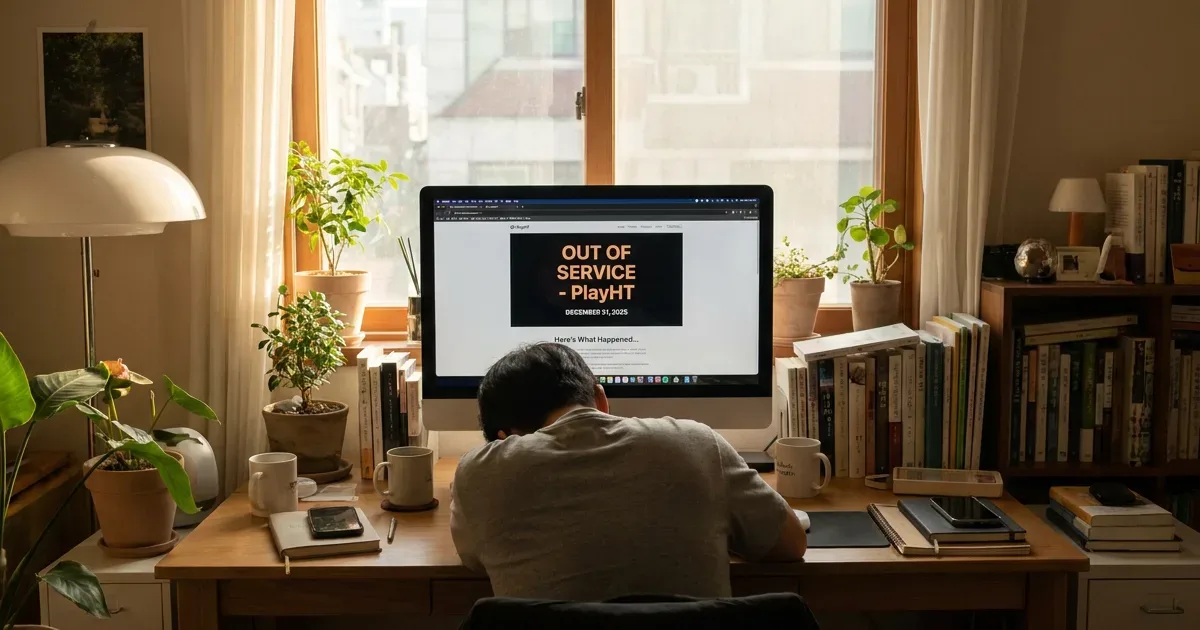
You’re searching for a PlayHT review because you want to know if it’s worth paying for. Short answer: PlayHT no longer exists. Meta acquired the entire team in July 2025, and on December 31, 2025, every account, every voice clone, and every saved project was permanently deleted — no migration window, no export, gone.
If you’re a creator who was using PlayHT or was about to sign up, this article covers what the platform was worth while it ran, exactly what happened, and — more practically — which three tools have picked up where it left off. The best replacement depends entirely on what you were using PlayHT for, and that distinction matters more than most “alternatives” roundups acknowledge.
Some links below are affiliate links. They don’t change what you pay, and tools are chosen on merit — including the parts where they fall short.
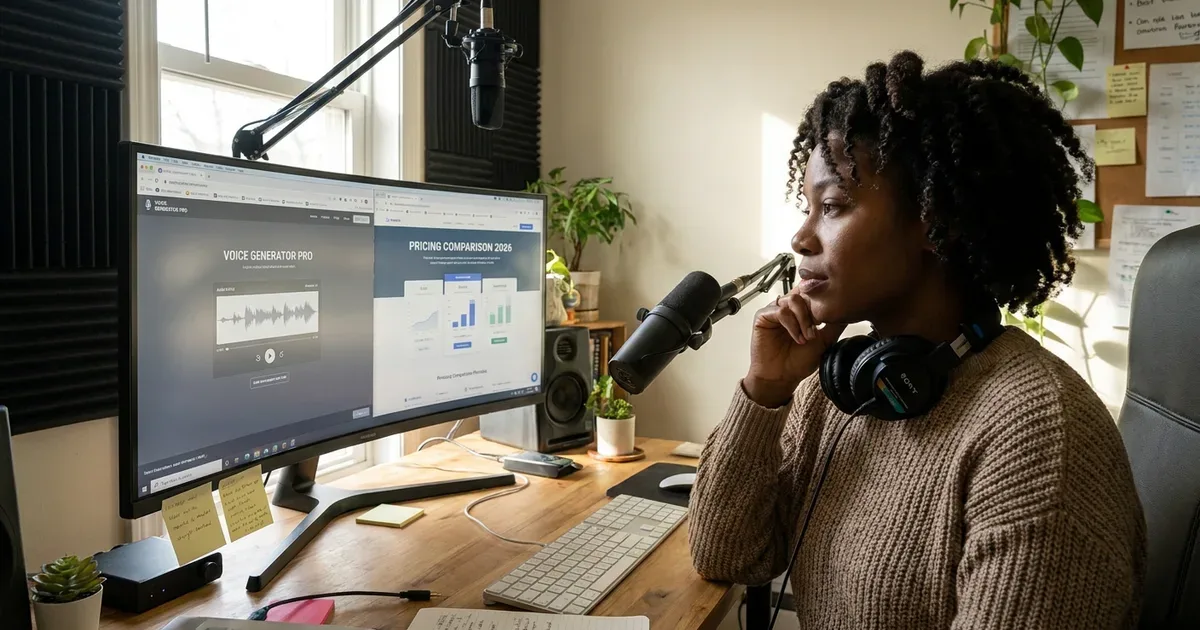
PlayHT Shut Down on December 31, 2025 — Here’s the Full Timeline
Meta made the acquisition public in July 2025. The entire 35-person PlayHT team moved into Meta’s Superintelligence Labs, where they now build voice features for Meta AI, AI Characters, and Meta’s wearable hardware. For the platform’s existing users, the warning signs arrived quickly and, in some cases, ahead of schedule:
- New sign-ups closed in August 2025
- The API went dark on July 26, 2025 — weeks before the publicly stated deadline
- December 31, 2025: complete shutdown, all data deleted with no migration path
The early API closure caught developers mid-production. Some customers were billed for November and early December 2025 and received no refund when the December 31 cutoff hit. This wasn’t a graceful wind-down — it was an acquihire where Meta absorbed the talent and IP, then wound down the consumer product because keeping it alive would have competed with Meta’s own roadmap and added moderation overhead.
There is no indication Meta plans to release a consumer PlayHT successor. The team is building internal voice infrastructure, not a product for independent creators.
What PlayHT Actually Offered (For Those Evaluating Historical Context)

When it was live, PlayHT was positioned as the price-competitive alternative to ElevenLabs — comparable voice quality at a lower entry price, with a flat-rate Unlimited plan that removed per-character anxiety entirely. Here’s what the platform looked like at shutdown:
- 800+ voices across 142 languages
- Instant voice cloning from a 30-second audio sample
- Per-word timestamps available even on lower tiers
- A genuinely unlimited character generation tier
Pricing at the time of shutdown (December 2025):
| Plan | Monthly Price | Characters | Voice Clones |
|---|---|---|---|
| Free | $0 | 12,500/month | 1 instant clone |
| Creator | $39/month | 250,000/month | 10 clones |
| Unlimited | $99/month | Truly unlimited | Unlimited |
The $99 Unlimited plan was the real differentiator. ElevenLabs’ Pro plan is also $99/month — but it runs on a credit cap. PlayHT’s Unlimited was character-unlimited with no ceiling. No current competitor has replicated that combination at the same price. That’s not a knock on the alternatives; it’s just the honest gap.
One less-discussed feature: per-word timestamps were available on lower tiers, including the free plan. This matters for creators syncing audio to video timelines. ElevenLabs supports timestamps, but access depends on your plan and API usage level. If you were relying on timestamps in your production pipeline, budget for that when evaluating replacements.
The Three Best Replacements Right Now

These cover different use cases. There’s no single tool that replicates everything PlayHT did — choose based on what you actually need.
| Tool | Best for | Watch out for | Price (at time of writing) |
|---|---|---|---|
| ElevenLabs | Realistic narration, voice cloning, long-form creators | Free tier caps out fast; no true unlimited plan | From $5/mo (Starter) |
| Murf AI | Video narration with integrated timeline editor | Sounds more “produced”; fewer language options | From $29/mo |
| Notevibes | Multilingual content creators | Weaker voice cloning than ElevenLabs | See official page |
ElevenLabs — closest to PlayHT for most creators
If you used PlayHT for realistic narration or voice cloning, ElevenLabs is the clearest match. The voice quality at its upper tiers is difficult to distinguish from studio recording — noticeably more natural than what PlayHT delivered on equivalent scripts. The Starter plan starts from $5/month (at the time of writing) and includes voice cloning, which makes it accessible for hobbyist and part-time creators.
For a practical scenario: if you run a YouTube channel posting two videos per week with 8-minute narrations, the Creator plan ($22/month) likely covers you without hitting credit ceilings. Run heavier volume — daily uploads, audiobook work, API integrations — and you’re looking at Pro ($99/month) before usage anxiety disappears.
The honest limitation: ElevenLabs’ free tier gives 10,000 characters per month. A typical YouTube script runs 1,200–1,500 words, which is roughly 7,000–8,500 characters. You’ll exhaust the free plan in about one video. Test the voice quality, then decide on the paid tier.
If your primary concern is language support: ElevenLabs handles Korean, Spanish, French, German, Japanese, and a number of others at high quality. For accent consistency in Korean-language content specifically, generate a short test sample before committing — intonation can drift on longer sentences. See Best AI Voice Generators for YouTube Creators in 2026 for a broader comparison across languages.
Murf AI — best if video editing is part of your workflow
Murf builds everything around a timeline editor. You can sync voice, background music, and slide or clip timing without leaving the platform. For marketers making product demos, educators recording course modules, or anyone where “voice plus visuals = one deliverable,” that integrated workflow is genuinely faster than exporting audio and reimporting into a video editor.
Plans start from $29/month (at the time of writing). The tradeoff is real: Murf’s voice output sounds clean and professional, but it has a “produced” quality that ElevenLabs’ top-tier voices don’t. It’s not robotic — it just doesn’t pass for spontaneous human speech the way ElevenLabs can at its best. Also, Murf covers fewer languages than PlayHT did, so multilingual workflows will hit limits.
Notevibes — worth checking if you publish in multiple languages
550+ voices across 72 languages with per-character pricing. If your content is primarily non-English — or you publish parallel versions in Korean, Spanish, and English — Notevibes is worth generating sample audio before committing to ElevenLabs. The voice cloning feature exists but is less sophisticated than ElevenLabs’. For pure multilingual text-to-speech without heavy cloning needs, it’s a legitimate option.
How to Pick Based on What You Were Actually Doing

PlayHT’s $99 Unlimited plan attracted two very different user types: high-volume individual creators who resented usage caps, and developers running TTS at scale through the API. The right replacement depends on which camp you’re in.
If you were a creator on the Unlimited plan — podcasts, long audiobooks, YouTube narration over 10 minutes — ElevenLabs Creator at $22/month is the best starting point on quality. You’ll encounter usage caps, but the voice realism is higher than PlayHT was. If you hit ceilings regularly, upgrade to Pro ($99/month), which gives you meaningful volume headroom.
If you were on the Creator plan ($39/month) for short-form content or marketing video, Murf’s integrated editor might actually serve you better than PlayHT did. You get timeline control PlayHT never offered.
If you were using the PlayHT API for a product or service — not just personal content production — neither Murf nor Notevibes is designed for that use case. ElevenLabs has the most mature developer API of the three. Pricing shifts to usage-based at that scale, so compare against your character volume before committing. If you need voice cloning in your app at scale, How to Clone Your Voice with AI (Free and Paid Options That Actually Work) covers the API landscape in more detail.
One legitimate frustration worth naming: there’s no current tool that matches PlayHT’s combination of truly unlimited generation plus per-word timestamps at $99/month. That specific bundle is gone. Factor it into your cost modeling if timestamps are part of your production pipeline.
Frequently Asked Questions

Q. Can I recover my PlayHT voice clones or saved projects?
No. Meta deleted all accounts, audio files, and voice clones on December 31, 2025. There was no export window and no migration path provided. If you had commercially valuable cloned voices, you’ll need to re-record source audio and re-clone using a new platform — ElevenLabs accepts samples as short as one minute for instant cloning.
Q. Is there any chance PlayHT comes back in 2026?
No credible indication suggests it will. The team is now building internal tools inside Meta Superintelligence Labs — voice features for Meta AI and hardware products, not a consumer TTS platform. This was a classic acquihire: Meta wanted the people and IP, not the subscriber base.
Q. Can I use ElevenLabs or Murf commercially for monetized YouTube videos?
Commercial licensing varies by plan on both platforms. ElevenLabs’ free tier restricts commercial use — for monetized content, you need a paid plan that explicitly includes a commercial license. Murf’s paid plans include commercial use rights. Check each tool’s terms page directly before publishing monetized content; licensing terms can and do change, and what applied at the time of writing may have been updated.
What to Do Right Now If You Were a PlayHT User
Don’t wait for a PlayHT successor to emerge from Meta. It’s not coming. The clearest path forward for most creators is to start with ElevenLabs’ free tier today — generate samples on two or three of your actual scripts and listen for the specific voice qualities that matter to your content. That 15-minute test will tell you more than any comparison table.
If you ran a production workflow tied to the PlayHT API, ElevenLabs’ developer documentation is the most mature starting point in 2026. Port your integration there first, then benchmark against cost and quality requirements.
And if you’re building a new voice workflow from scratch — no legacy PlayHT dependency — read through the alternatives above based on your specific output type. Realistic narration goes ElevenLabs. Video with synchronized visuals goes Murf. Heavy multilingual work goes Notevibes or back to ElevenLabs for the language breadth.
Start generating. The tool quality gap between platforms is real, and you’ll know within one video which one fits.